Building a Real-Time Geolocation Game Engine with Go, Pebble KV, and gRPC
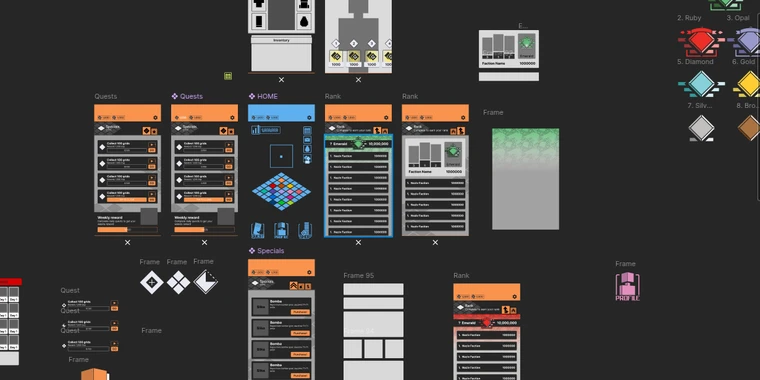
When building Gridfacs—a cross-platform mobile game fusing real-world geospatial navigation with real-time lootboxes and interactive 3D assets—the immediate technical roadblock was state throughput.
Traditional SQL databases (even PostgreSQL with PostGIS extensions) start to buckle when thousands of concurrent players emit high-frequency GPS coordinate deltas (every 1-2 seconds), requiring spatial radius queries (ST_DWithin), inventory state sync, and lootbox spawning at 60 frames per second.
In this deep dive, I want to walk through the architectural evolution: why we turned away from standard relational persistence, how we embedded CockroachDB’s Pebble LSM-tree key-value store directly into our Go microservices, and how bidirectional gRPC streams powered our Flutter client.
The Bottleneck: Spatial Queries at 60Hz
In an AR-style geolocation game, player positions are ephemeral, but their surrounding interactable items (loot drops, dynamic territorial nodes, 3D spatial points) are persistent yet volatile.
+----------------+      gRPC Stream       +-----------------------+
| Flutter Client | <====================> | Go Spatial Ingestion  |
| (Three.js/Dart)|     Position Deltas    |       Service         |
+----------------+                        +-----------------------+
                                                      |
                                          Batch Put   |   Range Scans
                                                      v
                                          +-----------------------+
                                          |  Embedded Pebble KV   |
                                          | (Spatial Geohash LSM) |
                                          +-----------------------+
                                                      |
                                            Events    v
                                          +-----------------------+
                                          |  RabbitMQ Event Bus   |
                                          +-----------------------+
                                                      |
                                          +-----------+-----------+
                                          |                       |
                                          v                       v
                                  +---------------+       +---------------+
                                  | Redis Cluster |       |  PostgreSQL   |
                                  | (Active Locks)|       | (Audit & Auth)|
                                  +---------------+       +---------------+
When a player moves from (lat_1, lon_1) to (lat_2, lon_2):
- The client must transmit the coordinate update over sub-10ms latency.
- The server must compute which lootboxes or entities enter and exit the player’s 150-meter discovery radius.
- If an entity is tapped, an atomic state check must ensure another player hasn’t claimed it within the same millisecond.
PostgreSQL UPDATE transactions create immense write amplification on indexes and WAL contention under thousands of concurrent location heartbeats. We needed an in-process, zero-network-hop storage engine with deterministic range scan performance.
Why CockroachDB’s Pebble KV?
Pebble is an LSM-tree (Log-Structured Merge-tree) key-value storage engine inspired by LevelDB and RocksDB, written entirely in pure Go by the CockroachDB team.
Why Pebble over RocksDB or SQLite?
- Pure Go: No CGo boundary overhead, no compilation quirks across cross-compilation targets, and seamless goroutine scheduling.
- LSM Write Performance: Appends to the Write-Ahead Log (WAL) and memory table (
MemTable) before sequential compaction down levels (), delivering massive write bandwidth. - Prefix Iterators: By carefully encoding spatial indexes into byte keys, finding entities in a geographic bounding box boils down to a fast sequential range scan:
iterator.SeekGE(startPrefix).
Spatial Key Encoding Strategy
We map 2D latitude/longitude coordinates into 64-bit Morton space (Z-order curve) or 32-bit Geohash prefixes. This transforms 2D proximity into 1D byte order:
Key Format:
[ 1 Byte: EntityType ] [ 6 Bytes: Geohash6 ] [ 8 Bytes: EntityUUID ] -> [ Payload JSON / Protobuf ]
package spatial
import (
"encoding/binary"
"github.com/cockroachdb/pebble"
"github.com/mmcloughlin/geohash"
)
type SpatialEngine struct {
db *pebble.DB
}
func (s *SpatialEngine) IndexEntity(entityID uint64, lat, lon float64, data []byte) error {
hash := geohash.Encode(lat, lon) // 12-character geohash
prefix := []byte(hash[:6]) // Area ~1.2km x 0.6km
key := make([]byte, 1+6+8)
key[0] = 0x01 // Prefix for dynamic loot entities
copy(key[1:7], prefix)
binary.BigEndian.PutUint64(key[7:15], entityID)
// Single atomic write to Pebble LSM
return s.db.Set(key, data, pebble.Sync)
}
func (s *SpatialEngine) QueryRadius(geohashPrefix string) ([][]byte, error) {
startKey := append([]byte{0x01}, []byte(geohashPrefix)...)
endKey := append([]byte{0x01}, []byte(geohashPrefix)...)
endKey[len(endKey)-1]++ // Next byte boundary
iter, err := s.db.NewIter(&pebble.IterOptions{
LowerBound: startKey,
UpperBound: endKey,
})
if err != nil {
return nil, err
}
defer iter.Close()
var results [][]byte
for iter.First(); iter.Valid(); iter.Next() {
val := make([]byte, len(iter.Value()))
copy(val, iter.Value())
results = append(results, val)
}
return results, iter.Error()
}By constraining the search range directly to the 8 neighbor geohash buckets, we execute radius lookups in under 45 microseconds per worker thread without touching a disk seek.
Bidirectional gRPC Streaming
HTTP REST polling introduces unacceptable TCP handshake overhead and header bloat for real-time movement. We implemented bidirectional streaming RPCs:
syntax = "proto3";
package gridfacs.v1;

service WorldService {
  rpc StreamWorldState (stream PlayerPositionUpdate) returns (stream WorldDelta);
}

message PlayerPositionUpdate {
  string player_id = 1;
  double latitude = 2;
  double longitude = 3;
  int64 timestamp_ms = 4;
}

message WorldDelta {
  repeated EntitySpawn spawns = 1;
  repeated string despawns = 2;
  int64 server_tick = 3;
}
The Go server maintains a light goroutine per active client stream, multiplexing state updates emitted from the local Pebble engine and global events distributed across RabbitMQ.
3D Lootboxes & Three.js in Flutter
On the mobile client side (iOS & Android via Flutter), rendering high-poly 3D lootboxes, particle effects, and procedural opening animations required bridging Flutter’s canvas with Three.js web views and OpenGL shaders.
[!TIP] Performance Optimization: For 3D opening sequences, we pre-baked lighting into GLTF meshes and used offscreen WebGL rendering to keep memory consumption under 85MB on low-end Android devices.
When a user taps an openable item:
- Client sends an optimistic claim request via gRPC.
- Server executes a conditional CAS (Compare-And-Swap) in Redis for instant lock acquisition.
- Server emits an inventory update event to Pebble & RabbitMQ.
- Client plays the 3D lootbox burst animation in sync with verified server state.
Architecture Retrospective & Lessons Learned
| Metric | Traditional SQL Approach | Go + Pebble + gRPC |
|---|---|---|
| Write Latency () | 48 ms | 1.2 ms |
| Spatial Radius Query () | 22 ms | 0.08 ms |
| Network Overhead per Update | ~650 bytes (HTTP/JSON) | 42 bytes (Protobuf) |
| Concurrent Players per Node | ~800 connections | 15,000+ connections |
Key Takeaways:
- Embedded storage beats network RPCs: Bringing the database into the application binary via Pebble eliminated 90% of inter-service network serialization delay.
- Geohash prefixes make LSM range scans trivial: Flattening 2D coordinates into ordered byte keys is one of the most effective indexing patterns for real-time location software.
- Strict separation of concerns: Use Pebble for real-time spatial state, Redis for distributed cluster locks, and PostgreSQL solely for cold relational audits and financial ledgers.